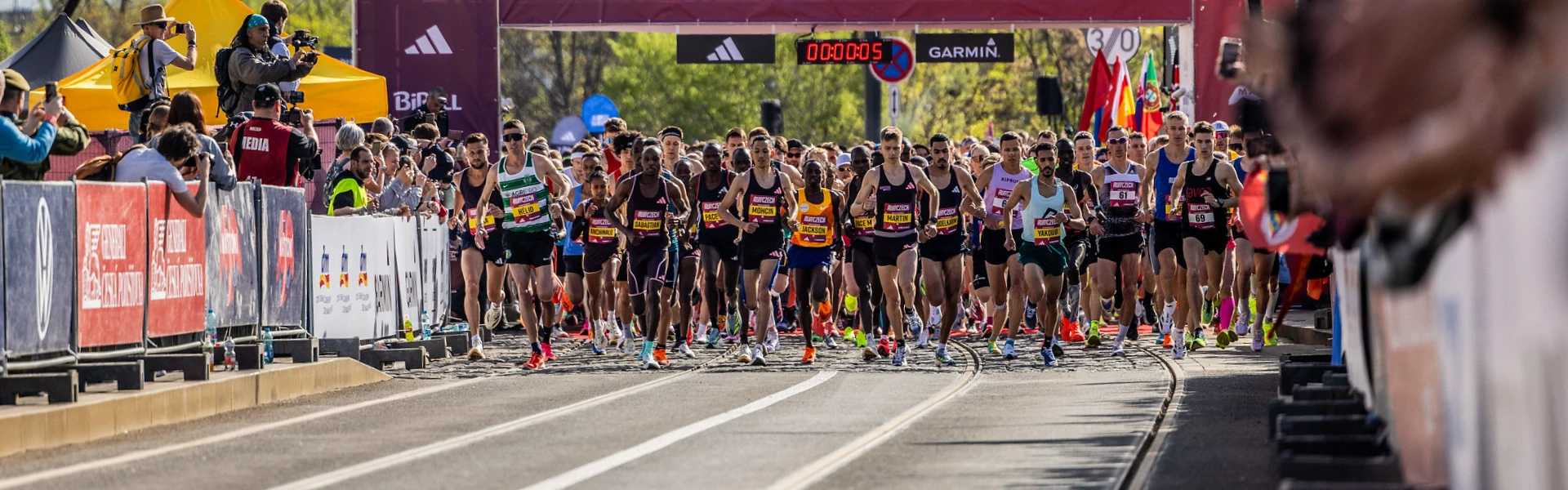
Prague Half Marathon is RunCzech’s third oldest running race. Its inaugural edition took place in 1999, just four years after the debut of the Prague International Marathon. At that time, the half marathon was known as the Kodak Prague Half Marathon.
The inaugural Prague Half Marathon took place on March 13, 1999, and followed a route through Stromovka Park. A total of 718 runners crossed the finish line. The f irst-ever winner was Ali Ezayedi of Libya with a time of 1:04:48.
Winner Isaac Kiprono defeated Italy’s Danilo Goffi in one of the closest finishes in the race’s history. In the women’s category, local runner Jana Klimešová defended her title. The number of participants exceeded 1,000 for the f irst time (1,088).
Runners set off from the iconic Charles Bridge, one of Europe’s most attractive landmarks. Under ideal weather conditions, the first Kenyan double was achieved, with Anthony Korir winning the men’s race and Florence Barsosio the women’s.
The race course was modified to make it more attractive and faster. The start and finish were moved to Old Town Square. RunCzech introduced new technological features—including “live tracking,” or the ability to monitor runners online—and also offered virtual training software for runners.
Hervis became the title partner of the event. For the first time, organizers registered more than 2,000 runners—2,176, to be exact. The race was held under the auspices of AIMS (Association of International Marathons and Distance Races).
Race records were broken in both categories. Kenyan Joseph Ngeny became the first runner in the history of the competition to break the 62-minute mark (1:01:46), and his compatriot Catherine Kirui broke the 71-minute barrier (1:10:38).
The number of half-marathon participants set another record, rising to 2,744. Kenyan winner Silas Kirui broke the race’s all-time record with a time of 1:01:07.
In a field of 3,148 runners, Kenyan long-distance runners dominated both categories for the third consecutive year. Caroline Kwambai won in a race record of 1:10:08. RunCzech organized a corporate relay race, in which approximately 100 four-member teams participated.
Two-time world cross-country runner-up Patrik Ivuti of Kenya set a record time of exactly 61 minutes.
The number of participants reached a record high of 4,243. The race started in front of the Rudolfinum; Charles Bridge was undergoing partial reconstruction. The 2008 Hervis Prague Half Marathon was classified as a World Athletics Silver Label Road Race.
A landmark year for this event. Impressive race records were set by Kenyan runners: 1:00:07 by Nicholas Kipruto Koech and 1:09:03 by Rosa Kosgei. Hervis Prague Half Marathon was upgraded by World Athletics to the Gold Label Road Race category after 2009 edition
Prague Half Marathon, now holding Gold Label Road Race status, attracted nearly 9,000 runners to the starting line. Among them were many prominent figures, including Golden Ball winner Pavel Nedvěd.
For the first time in history, a half marathon was run in under an hour in the Czech Republic. The winning time of 59:30 set by Philemon Limo of Kenya became the f ifth-best performance in the world that year, and Prague thus joined the ranks of the world’s top halfmarathon destinations. The women’s race was won by Lydia Cheromei, whose time of 1:07:33 was the best in Europe in 2011.
Prague Half Marathon announced an attempt to break the world record. Defending champion Limo finished third, while Ethiopian Atsedu Tsegay won convincingly, falling 24 seconds short of the alltime best time. Even so, his time of 858:47 propelled Prague to the top of the world rankings for the entire season. Joyce Chepkirui ran the second-fastest time in the world this year and set a new race record of 1:07:03. Prague Half Marathon also features supporting events, such as the 10K Run.
World record holder Zersenay Tadesse takes the starting line. The World and Olympic medalist won with a time of 1:00:10. The winner of the women’s race, Gladys Cherono, became the first female runner in history to break the 67-minute mark in the race, making the Prague Half Marathon the fastest of the 2013 season.
In near-perfect running weather, Kenyan Peter Kirui (59:22) won, kicking off a long, still-unbroken streak of winners, all with times under 60 minutes. In the women’s race, Joyce Chepkirui returned to the top spot after two years and moved into second place in the world rankings for the entire season. Her time of 1:06:19 marked another improvement of the race record. Prague Half Marathon has a new title sponsor, Sportisimo.
For the first time in the race’s history, more than 9,000 runners (9,065) crossed the finish line. Ethiopian runner Worknesh Degefa ended the six-year dominance of Kenyan runners with a time of 1:07:14, finishing sixth in the final world rankings of the season. The event was part of the RunCzech Running League.
Twelve thousand runners lined up at the start of the race. In the men’s category, a defending champion won for the first time in history; Kenyan Daniel Kyniua Wanjiru ran the fourth-fastest half marathon of the season in 59:20. The winner of the women’s race, Violah Jepchumba, remained at the top of the world rankings until the end of the year, and with a time of 1:05:51, she hinted that Prague might soon be in a position to challenge the world record.
And they did it! The all-time best time in the women’s half marathon, 1:04:52, was broken in Prague. Kenyan Joyceline Jepkosgei became the first woman ever to break the 65-minute mark. Joyceline also broke the 10-, 15-, and 20-kilometer world records. Among the men, the eventual Olympic and world champion, Ethiopian Tamirat Tola, dominated the race. Elite Czech longdistance runner Jiří Homoláč set the still-standing Czech race record of 1:03:23.
The best Czech performance of the race came in the women’s category. Eva Vrabcová Nývltová, the current manager of the RunCzech Racing Team, set a new national record with a time of 1:11:01. Kenyan winner Joan Melly ran an excellent time of 1:05:04, finishing third in the world rankings for the year, and Prague once again became the fastest half marathon in Europe.
Of the 10,554 runners who crossed the finish line, the fastest was Kenyan Benard Kimeli, who defended his title with a time of 59:07. Together with his compatriot Felix Kibitok (59:08), they broke into the top eight of the world rankings for the year.
Despite the challenges posed by the COVID-19 pandemic, RunCzech managed to hold a Half Marathon. The race was titled “Ready for the Restart” and took place on a short circuit reserved for selected elite athletes, with separate starts for each category. Peres Jepchirchir, who would later become an Olympic and world champion, broke the world record in the women-only half marathon with a time of 1:05:34!
Unfortunately, Prague Half Marathon was canceled due to ongoing pandemic restrictions.
Interest in the race remained high even after the break, with nearly 7,000 runners crossing the finish line. For the eleventh time in history, Kenyan athletes (Philemon Kiplimo and Nesphine Jepleting) won in both categories. Participants had the opportunity to use the RunCzech app, which utilizes modern technology to manage the race and results. The SuperHalfs series kicked off, featuring the Prague Half Marathon alongside five other elite half marathons in Europe.
More than 10,000 runners participated in Prague Half Marathon. The running festival in the Czech capital also featured a 4×5 km relay and the Medical Run.
Registration for the race was completely sold out, and a record number of 13,494 participants crossed the finish line. Kenyan Sabastian Sawe set a new race record of 58:24, which remained at the top of the world rankings for nearly six months.
Prague Half Marathon celebrates its 25th anniversary. Generali is the title partner of the event. The top two men broke the 59-minute barrier. The times set by Rodrigue Kwizera (58:54) and Isaiya Lasoi (58:56) ranked among the world’s top 15 performances of the year. Thanks to Lilian Rengeruk’s winning time of 1:05:27, the race became the fifth-fastest half marathon in the world. The record for the number of participants rose to 16,000.