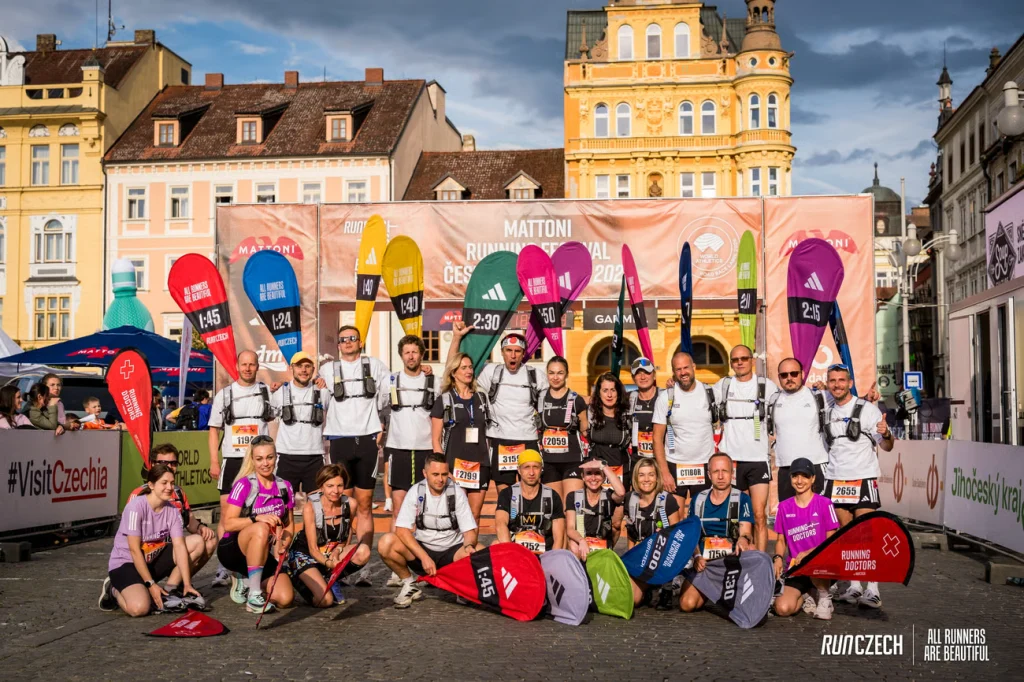
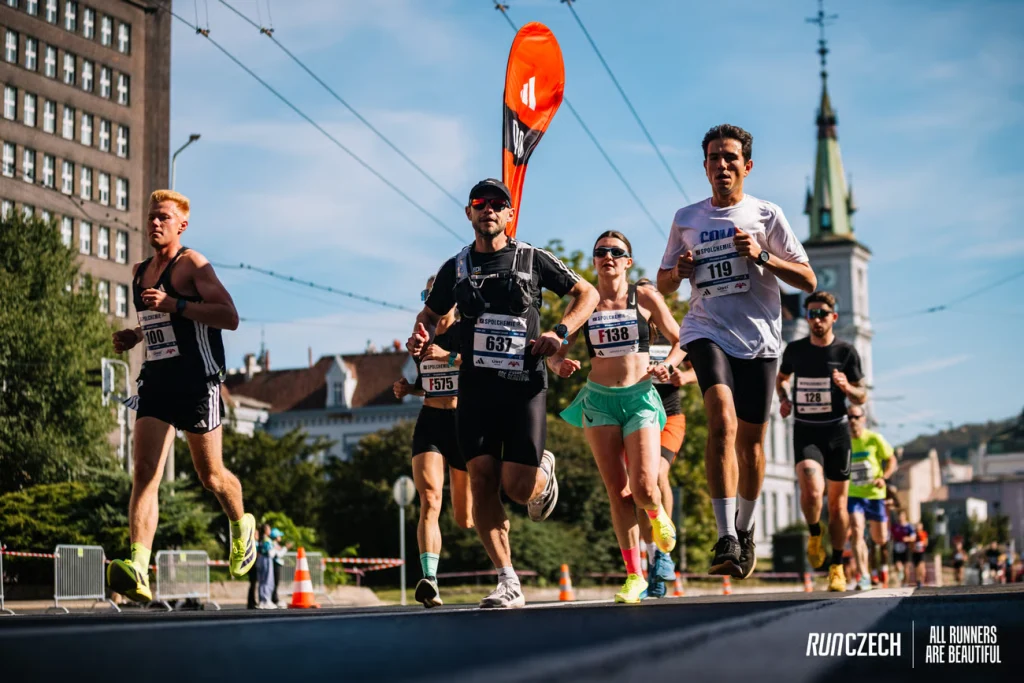
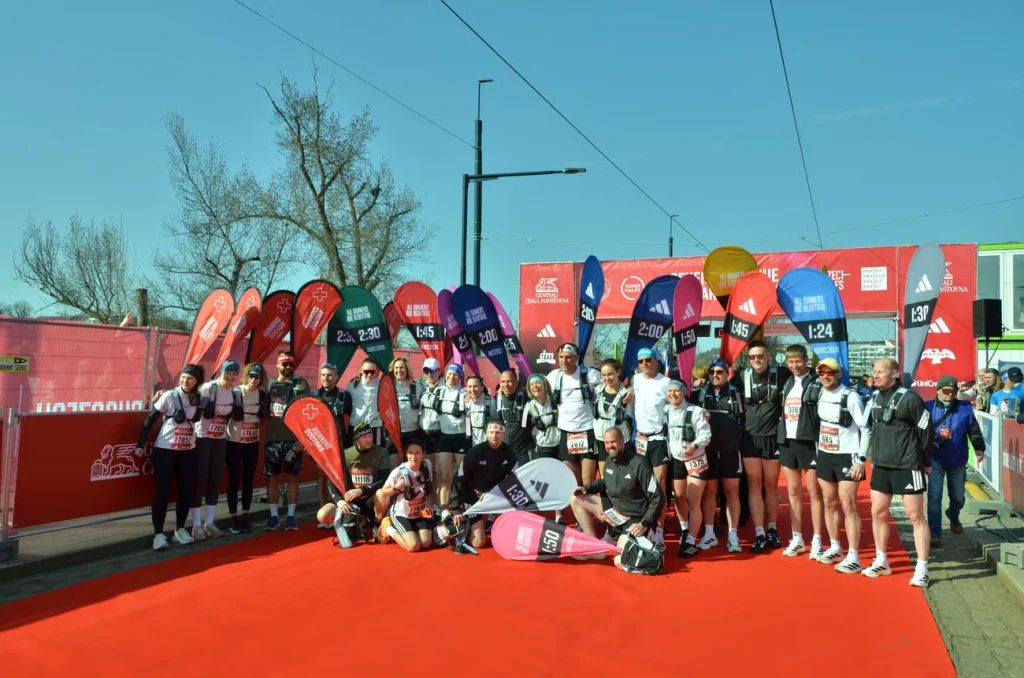
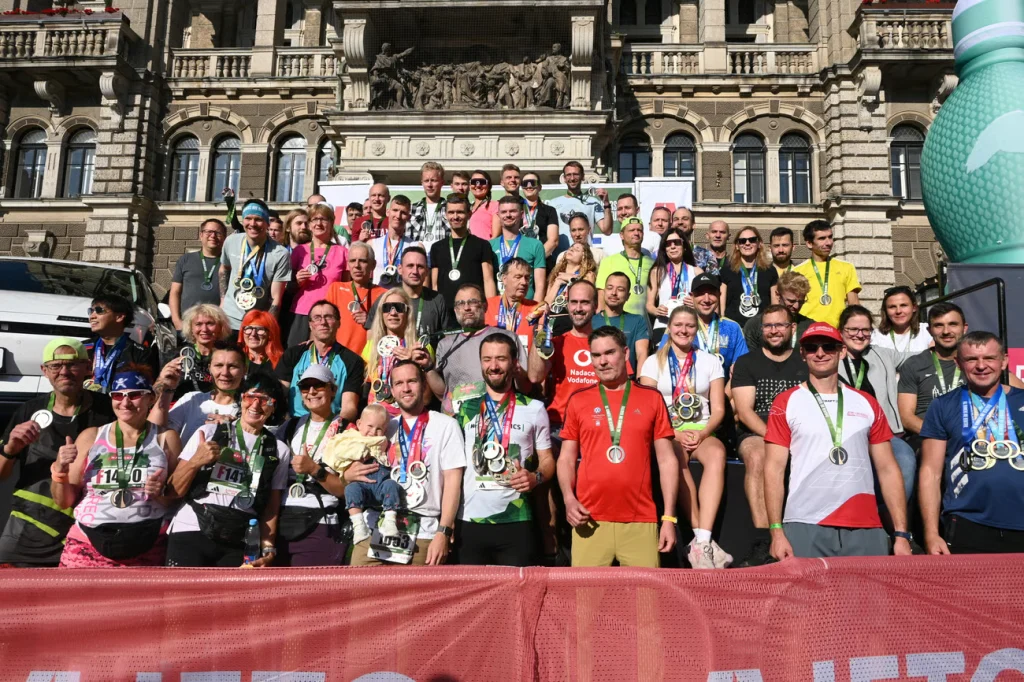
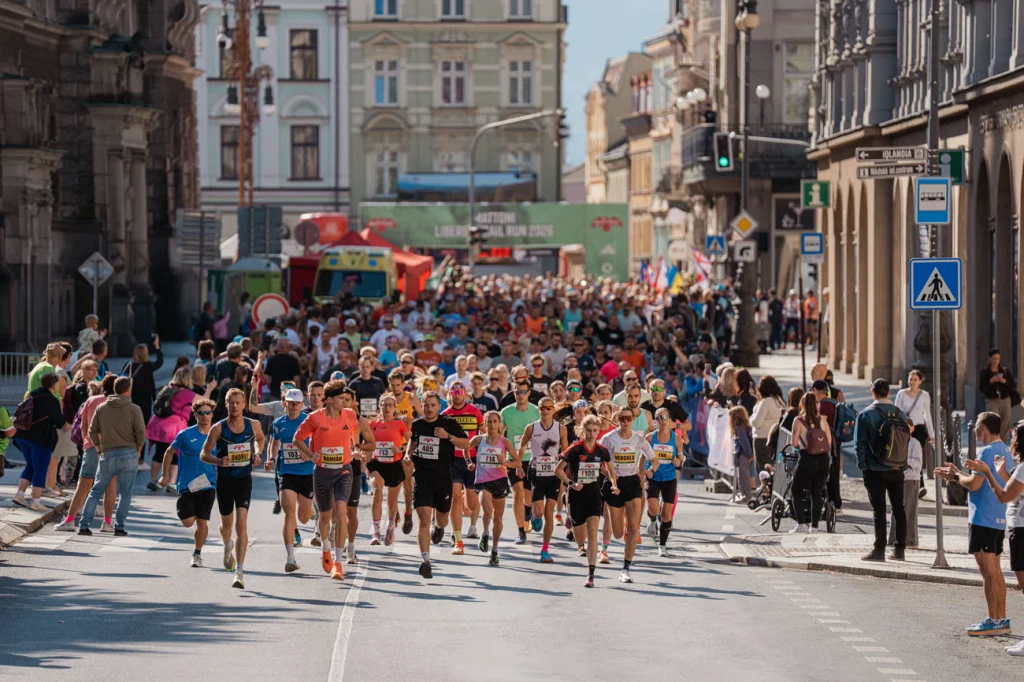
RunCzech pacers are experienced runners marked with a colorful flag showing their target time, who voluntarily gather from all over the Czech republic to support runners in their efforts. They are passionate individuals with a high degree of discipline and empathy, able to stay calm in crisis situations and motivate others to reach their dream time goals. Jiří Fix has been leading the RunCzech pacer team for six years; he has been racing since 2013 and has gathered pacing experience at foreign races as well. Experienced pacers Lukáš Kužel and Pavlína Broďáni described to us in detail what this role entails.
“I gained my first pacing experience at the Olomouc Half Marathon in 2025. Before that, I was part of a running training group with Petr Macek, who was already a pacer. I asked him for all the details, and after a phone call with captain Jirka Fix, the decision was made,” described Lukáš, who has put the flag on his back seven times since his premiere in Olomouc, about his beginnings as a pacer. “I got into pacing completely by chance in 2021. Jiří called me back then saying they lost a pacer. I enjoy running, and the feeling that I could also be helpful to someone made sense to me. At the race, I met my friend Jarda, and together we paced another four seasons,” added Pavlína, who already has over 20 races under her belt in the role of a pacer.
Although they love running, they don’t chase individual achievements. “With age and circumstances, the amount of quality training decreases, and performance along with it. Once a person tastes a certain pace, they know what lies behind it. Currently, I am more drawn to pacing itself or faster races with my son in a stroller. But sometimes it needs to be spiced up with a solo race. Then I try not to look back at the past and go according to my current fitness and possibilities,” explained Lukáš. “For me, pacing is about powerful experiences, and it recharges me a lot. As I said, I enjoy helping others,” agreed Pavlína, who in the past also tried the role of a volunteer taking care of the pacers themselves during the marathon.
Energy exchange and mutual empathy
Both view the role of a pacer in a much broader context than just as “live stopwatches”. For Lukáš, it is primarily about the mutual energy shared between runners and spectators. “I like to compare it to the relationship between a band at a concert and its fans. We send energy back and forth to each other. I see further value in the opportunity to fire up not only the runners, but also the spectators along the course. And the final bonus is bringing a little joy to the youngest ones – high-fiving them and feeling their enthusiasm. Showing the way to active movement is especially important these days. The reward in the form of a runner almost in tears who fulfilled their personal sports dream thanks to a pacer is simply the ultimate,” he shares his perspective.
Pavlína builds her role on empathy and understanding the community: “I can sense how runners feel because I am one of them. I started at similar times. Helping feels completely natural to me, and I have no ambition to push myself higher – here, I am among my own.”
Reactions on the course and at the finish line are very diverse. While some competitors discuss every second of pace with the pacers, others seek calm and a constant rhythm within the pack. According to Pavlína, the most beautiful thing is meeting the same faces along the routes who proudly acknowledge them.
Movie quotes and unusual “doping”
Over tens of kilometers, countless unforgettable and humorous situations naturally arise. Lukáš likes to entertain those around him with improvisation – from shouting out movie quotes to spectators in windows, to a relaxing welcome to the “running travel agency”, to an unplanned finish with his son in his arms. He also has one tangible memory of intense contact with fans: “After the race, I looked at my left wrist and saw a strange, dotted bruise. Only after a moment did I realize it was an imprint from the watch strap of one of the runners I had high-fived on the course,” he recalled with a laugh.
Pavlína, with a smile on her face, recalled an episode from Olomouc with a very unusual motivation of one of the runners. “A guy was running with us who claimed he had been promised ‘doping’ when things got worse. Eventually it turned out he had a friend on the phone who had special motivation for him via FaceTime in case he couldn’t go on. He amused us, the doping actually happened, and the guy finished safely.”
Courses close to the heart and atmosphere along the route
Every race in the RunCzech series offers a unique backdrop. For both Lukáš and Pavlína, Olomouc takes first place with its fantastic and passionate spectators, alongside picturesque Karlovy Vary or iconic Prague. Pavlína also swears by Ústí nad Labem: “When else do you get the chance to run through a chemical plant?”
Weaker moments for pacers naturally come in sections with sparse spectator crowds. “I enjoy the quiet stretches less, for example in České Budějovice or during track construction work in Ústí. Overall, however, fan support along the route is at a high level, and it boosts the overall race experience immensely. RunCzech promotes this brilliantly,” praises Lukáš.
Responsibility with a flag on your back
Carrying a flag with a target time on your back means a big commitment to all the runners in the group. For the pacer’s role to be both a show and a reliable support, a sufficient performance reserve is required. Lukáš estimates that under ideal conditions, he would run a half marathon 8 to 9 minutes faster without the flag. Nevertheless, pacers are not immune to weaker moments either. “With more races, fatigue accumulates, minor complications arise, and the machine runs a bit rougher. But the key is to run most of the race comfortably, encourage the lead group, and hype up the spectators,” he explains.
Sometimes, however, health complications or injuries occur on the course. “We are only human too, and we only have one health. When anything happens, we pack – sometimes with tears – the flag into the backpack and do not finish the race,” Pavlína openly admits. And Lukáš added that in such moments, there is nothing left to do but jog the rest of the route or withdraw from the race with a lowered bib number.
Key to success? A system in recovery
To manage the demanding race calendar, they do not underestimate proper post-finish recovery. Lukáš likes the system and order in recovery: “Whatever a person doesn’t recover after training is as if it never happened. Rule number one is to treat oneself to quality food containing carbohydrates and proteins, hydrate sufficiently, and enjoy it in good company. Immediately after finishing, I try to jog a kilometer or two, and sleep is key. The day after the race I chose a light jog, and the second day a complete rest from sports.” Pavlína then briefly summarizes the golden rule of every endurance athlete: quality food, fluids, and plenty of rest.
And what message would the pacers send to all runners and fans along the course? Above all, not to be afraid to connect and discard unnecessary inhibitions. “Mainly, people shouldn’t be afraid to talk to us, shouldn’t address us formally, and we should all enjoy it together,” says Pavlína.
Lukáš complements her words with a final reflection: “Pacers are here mainly for you, the runners. Let’s need each other in a sporting way, and endorphins before the finish line are guaranteed for everyone. And remember – not just a long run, but life itself is an endurance discipline.”