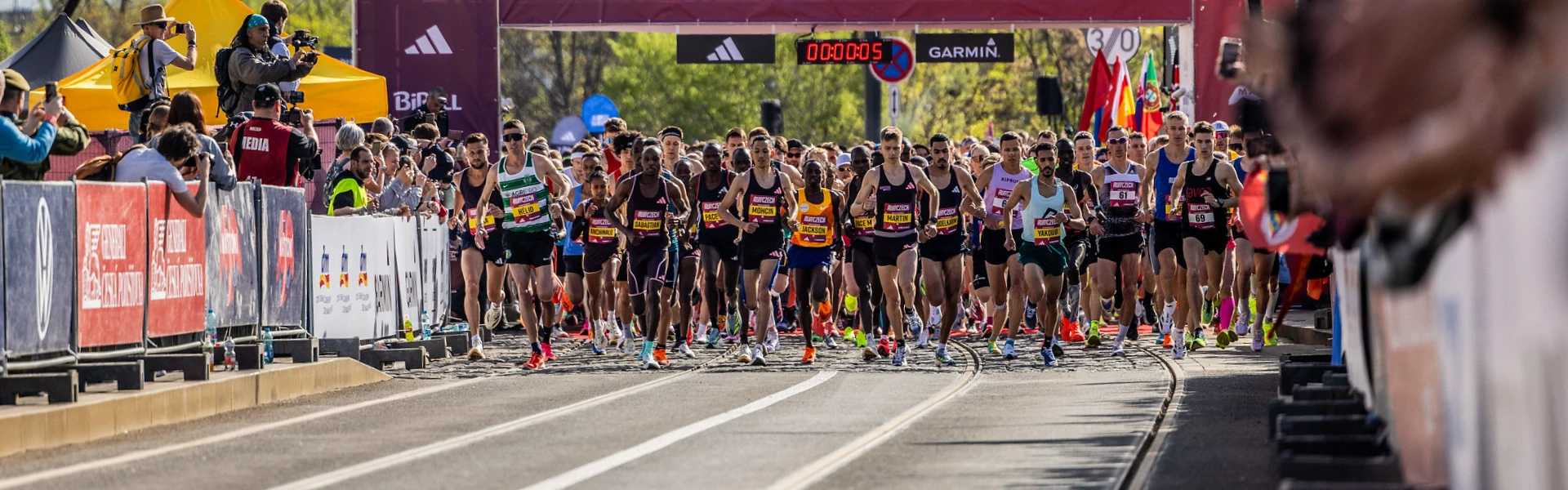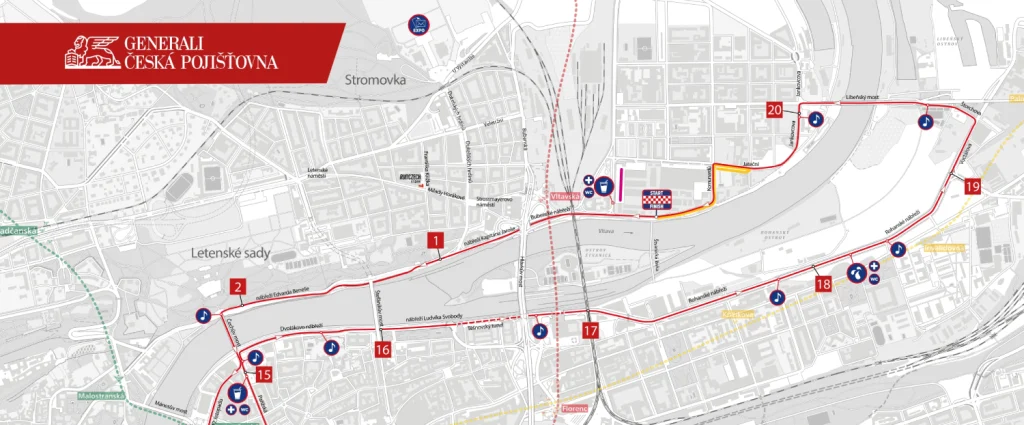
The points of interest along the race course are mentioned below, arranged following the course from start to finish.
HolKa footbridge | lávka HolKa (at start/finish)
A new footbridge connecting Karlin, Stvanice and Holesovice. The Stvanice footbridge, also known as the HolKa footbridge, is designed for pedestrians and cyclists and is the 20th Vltava river bridge in the capital. The footbridge features a modern, minimalist design.
Metronome | Metronom (at 2 km)
The gigantic Metronome occupies a symbolic spot on the map of Prague. It was directly on this spot that a gigantic monument to Joseph Stalin overlooked the city. It was demolished by dynamite in 1962, many years after his death. The seven-ton Metronome was installed in 1991 and was meant to be a symbol of the new era. The area surrounding it is now a paradise for skateboarders.
Chapel of St. Mary Magdalene | kaple sv. Máří Magdalské (at 2 km)
The early Baroque chapel of St. Mary Magdalene near Cechuv Most Bridge was built in 1635. The interior of the chapel features wall frescoes dating back to the chapel’s foundation and representing biblical plants, with particularly noteworthy ceiling stuccos.
Rudolfinum (between 2 km and 3 km)
Prague’s most prestigious concert hall, home of the Czech Philharmonic, which performed here for the first time in 1896 under the baton of Antonín Dvořák. The Neo-Renaissance building was built from 1876 to 1884. Originally it had a picture gallery, museum collections and a concert hall; in 1918—1938 and 1945—1946 it served as the National Assembly building. The main hall — Dvořák Hall — is the venue for exceptional concerts of classical music.
Jewish Museum in Prague – Old Jewish Cemetery (between 2 km and 3 km)
The cemetery was founded in the first half of the 15th century. Burials took place here until 1787. The most important person buried in the Old Jewish Cemetery is undoubtedly the great religious scholar and teacher Rabbi Judah Loew ben Bezalel, known as Rabbi Löw (d. 1609), with whom is associated with the legend of the artificial creature — the Golem.
Clementinum | Klementinum (at 3 km)
Albert Einstein held lectures, and Wolfgang Amadeus Mozart played numerous times here. Clementinum is Prague’s second largest building complex after Prague Castle and houses the most beautiful library in the world. Among the 27,000 old printed works are Kepler’s writings with his handwritten dedication to his friends, the dean and other Prague university professors. The Jesuits founded Clementinum in 1556 and named it after the former Dominican monastery of St Clement from 1227, where they settled. In 1775, meteorological data began to be collected here regularly making Prague a place of the oldest continuous meteorological observations in Europe.
Old Town Bridge Tower | Staroměstská mostecká věž (at 3 km)
The Old Town Bridge Tower is one of the most beautiful Gothic gateways in the world. The tower, along with the Charles Bridge, was built by Emperor Charles IV according to designs by Petr Parléř in the mid-14 th century. The gate to the Old Town was also conceived as a symbolic victory arch through which Czech kings passed on their coronation processions. For an unforgettable view, visitors must climb 138 steps to the viewing gallery.
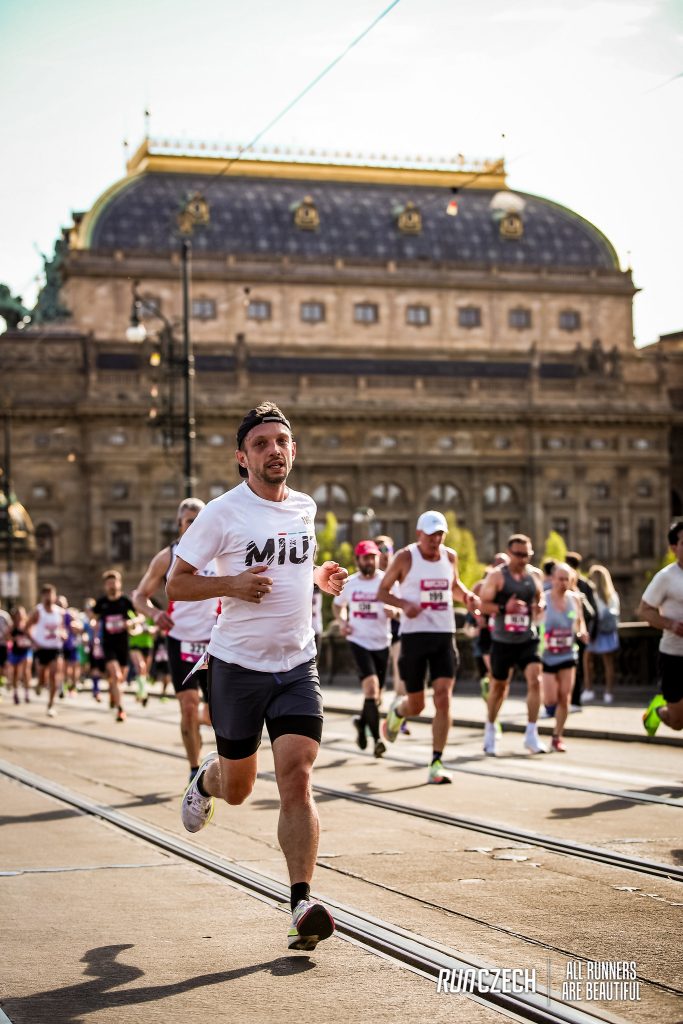
National Theatre | Národní divadlo (between 3 km and 4 km)
The National Theatre is the Czech Republic’s representative stage, built with funds from a nationwide collection and first opened in 1881, and for the second time in 1883 after a devastating fire. The spectacular exterior and interior decoration, richly embellished with gold, consists of masterpieces of 19th century Czech painters — Aleš, Ženíšek, Hynais, Myslbek, and others. Visit drama, opera and ballet performances together with beautiful spaces unforgettable theater experience.
Císařská louka Island (at 7 km)
An island of active relaxation, full of traditional and novelty sports activities great for families with children, for whom there is a ready assortment of fun activities.
Dancing House | Tančící dům (between 10 km and 11 km)
This pillar of modern architecture in Prague “danced” onto the Rašínovo Embankment in 1996. The project comes from the drawing board of world-renowned architects Vlado Milunić and Frank O. Gehry. Its concept was inspired by the dance skills of the famous film couple — the stone tower symbolizes Fred Astaire and the glass tower, his partner Ginger Rogers. A gallery and a restaurant with a terrace offering a 360° view of Prague can be visited in the Dancing House.
Museum of Prague – The Podskalská customs office at Výtoň | Muzeum Prahy – Podskalská celnice Na Výtoni (at 11 km)
The Podskalská Customs Office at Výtoň is the last monument that commemorates the beautiful and forgotten times of the Podskalí settlement and the hard work of the Vltava River rafters. It’s located on the river embankment in a building from the 16th century. The exhibition is dedicated to the history of the extinct Podskalí settlement, the life of its people, the history of
freight and passenger transportation on the Vltava River, and the beginnings of the Vltava steam navigation.
Emmaus Monastery „Na Slovanech“ | Klášter Na Slovanech (Emauzy) (at 12 km)
The unmistakeable modern white towers with gilded spires dating to the 1960s mark the Benedictine monastery Na Slovanech, whose original steeples were destroyed by fire in 1945 during a bombing raid. The church was founded by Charles IV in 1347 and became a centre of learning, art and Slavic literature. In the cloisters you can find the remains of priceless Gothic wall paintings; the Church of the Virgin Mary is painted in Beuron style.
Mánes Gallery | Galerie Mánes (between 12 km and 13 km)
The Mánes Exhibition Hall was built in 1930. It stands on concrete pillars over the branch of the Vltava flowing between the Masaryk Embankment and Slavonic Island. Thanks to its unique Functionalist design, visiting the Mánes Hall provides an opportunity not only to admire the perfection of the building, but also to experience the view of some of the beautiful nooks of Prague.
Národní Street | Národní třída (at km 13)
On November 17, 1989, the National street became the site of brutal intervention by the ruling Communist authorities, against defenceless college students. Their peaceful manifestation ended up in a face-off, whose dramatic developments, especially the brutality of special police divisions and arrests of the protesters brought revulsion and a welling-up of civic unrest. The memorial plaque at Kaňkův dům half way down Národní street is a constant reminder of how the Velvet Revolution began.
Wenceslas Square | Václavské náměstí (between 13 km and 14 km)
This square is the commercial and administrative centre of the city as well as the site of important social and historical events. Here you’ll find cinemas, theatres, banks, hotels, restaurants, dozens of small and large shops, and administrative centres. The square was created during the founding of the New Town by Charles IV in 1348. Today it is dominated by the National Museum (1885—1891) and Josef Václav Myslbek’s statue of the national patron St Wenceslas from 1912.
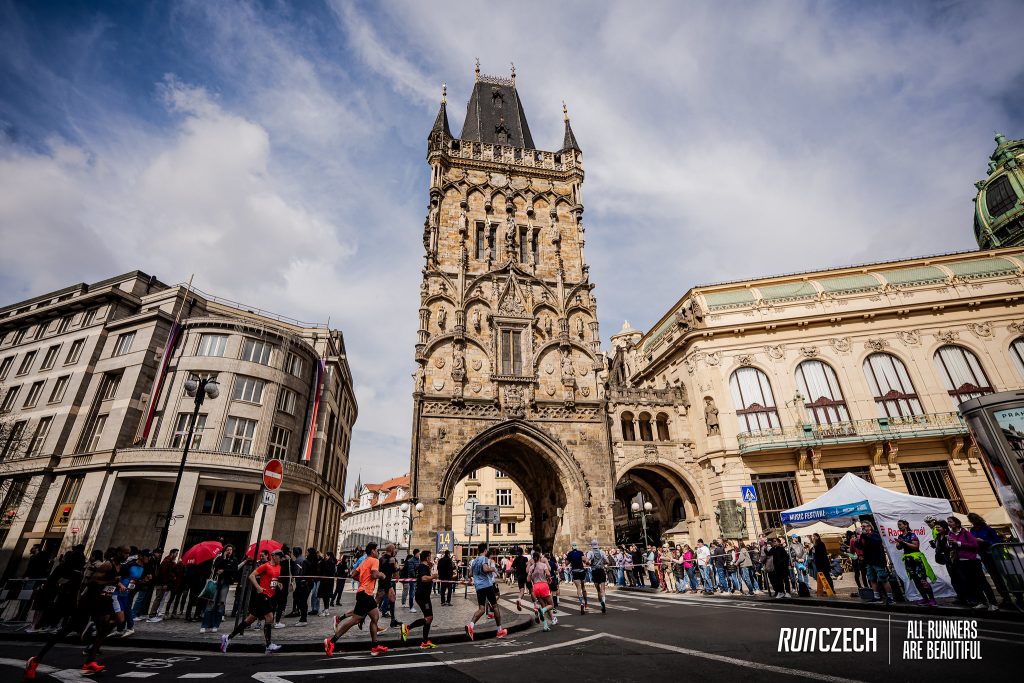
Powder Gate Tower | Prašná brána (at 14 km)
This monumental entrance by which the coronation processions of Czech kings entered the Old Town is one of the most significant monuments of Late Gothic Prague. Completed in 1475, the Powder Gate Tower, which formerly served as a gunpowder store, is still the starting point for the Coronation or Royal Route to Prague Castle. The viewing gallery is located at a height of 44 m.
Municipal House | Obecní dům (at 14 km)
This Art Nouveau building, built from 1905 to 1911, is proof of unprecedented artistic and craft skills and quality. The cafe, the French and the Pilsner restaurants, the American bar, the Lord
Mayor’s Salon and the Smetana Hall are all examples of perfectly executed Art Nouveau interiors, decorated by leading artists and sculptors such as Alfons Mucha.
Museum of Decorative Arts in Prague – House at the Black Madonna | Uměleckoprůmyslové museum v Praze – dům U Černé Matky Boží (between 14 km and 15 km)
A masterpiece of Czech Cubist architecture, the building was constructed from 1911 to 1912 according to designs by the Czech architect Josef Gočár. It’s located in the Old Town between Celetná Street and Ovocný trh. Its name comes from the Baroque statue that is located on its corner. After a complete renovation the building has become home to a Museum of Decorative Arts exhibition about Cubism.
Old Town Square | Staroměstské náměstí (between 14 km and 15 km)
The most significant square of historical Prague, it was founded in the 12th century and has been witness to many historical events. In addition to the Old Town Hall and the Church of Our Lady before Týn, the square is dominated by the Baroque Church of St Nicholas, the Rococo Kinský Palace, the Gothic House at the Stone Bell and the monument to Jan Hus. In the pavement of the square are memorial stones marking the execution of 27 Czech lords in 1621, and the Prague meridian.
Old Town Hall with Astronomical Clock | Staroměstská radnice (between 14 km and 15 km)
An icon of the Czech Republic, a national cultural heritage asset, a symbol of Prague’s history and the oldest institution of Czech self-government. At the end of World War II, its underground served as the centre of the Prague Uprising against Nazism and the town hall was almost destroyed by shelling. Not even the bell from 1313 survived, and the altar of the Chapel of the Virgin Mary was also severely damaged. However, the people of Prague repaired their national treasure and today you too can enjoy the Old Town Astronomical Clock with the procession of the twelve apostles, the majesty of the state rooms, the tenderness of the Chapel of the Virgin Mary and the mysterious Romanesque-Gothic underground. Be sure to take a ride to the top of the Town Hall Tower in our space elevator, which offers a beautiful view of the whole of Prague.
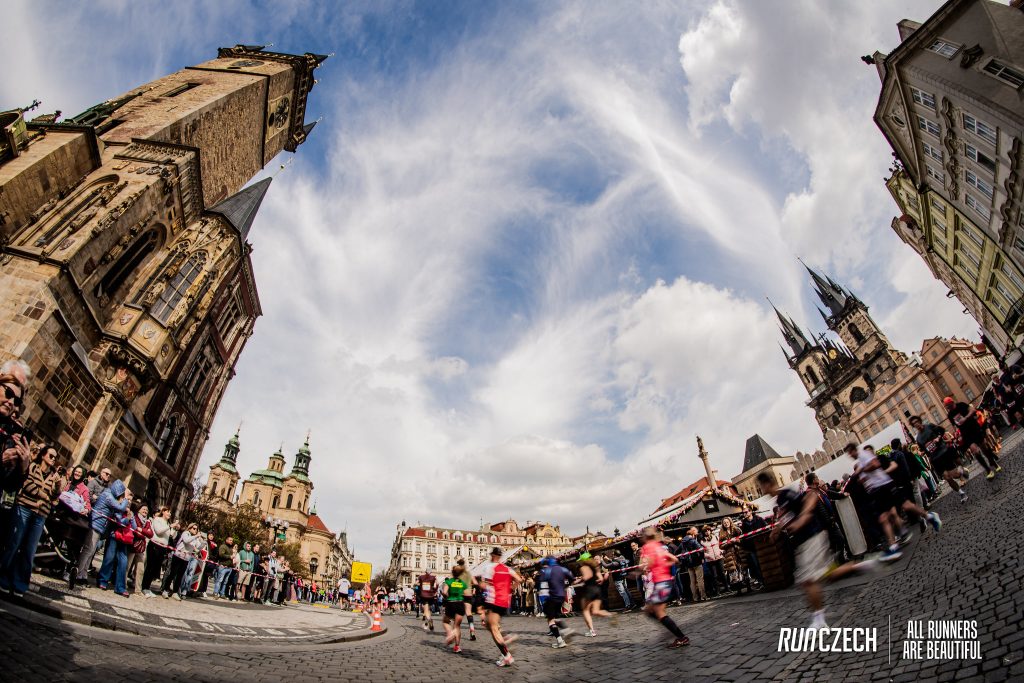
St Nicholas Cathedral – Old Town | chrám sv. Mikuláše – Staré Město (between 14 km and 15 km)
This monumental Baroque church was built from 1732—1737 according to plans by Kilián Ignaz Dientzenhofer. The side facing Pařížská Street has since been subsequently rebuilt during modern times. The interior, with its interesting lighting effects, is dominated by a crystal crown chandelier from the Harrachov glassworks, donated by russian Tsar to the Orthodox Church. Today the Czechoslovak Hussite Church uses the building is as a concert hall.
Pařížská Street | Pařížská ulice (at 15 km)
Pařížská Street traverses the Jewish Town of Prague, connecting Old Town Square with Čechův Bridge. It is lined with stately townhouses whose façades combine historicist features
with the decorative detail of Art Nouveau. Pařížská Street is Prague’s most prestigious boulevard, home to a wide range of luxury boutiques representing the world’s most prominent fashion brands.
National Gallery – Convent of St Agnes of Bohemia | Národní galerie – Klášter sv. Anežky České (between 15 km and 16 km)
The St Agnes Convent is one of the most important Gothic buildings in Prague. It was founded around 1230 AD by the Premyslid princess St Agnes of Bohemia along with her brother King Wenceslas I. The guided tour traces the history of the individual parts of the uniquely preserved medieval monastery. All major areas are accessible for viewing, including the Oratory of St Agnes, the Shrine of the Saviour, and the Church of St Francis, where the remains of King Wenceslas I are buried.
New Mill Water Tower | Novomlýnská vodárenská věž (at 16 km)
The tower was built in the Baroque style in 1658 on what remained of the original Renaissance tower, destroyed by a flood in 1655. It supplied water to the lower New Town of Prague and served its original purpose until 1877. The Tower has undergone a complete renovation, and now houses an exhibition about Prague’s fires in the past and a history of Prague’s fire-fighters.
Lilith statue | socha Lilith (between 18 km and 19 km)
The 24-meter-high statue of a woman, made of chrome-nickel polished steel by David Cerny, has become the new landmark of the Karlin district. The figure of the mythical Lilith symbolically holds up the new Fragment residential building. Always after midnight, the 35-tonne statute turns its head by 180 degrees.
Prepared by prague city tourism