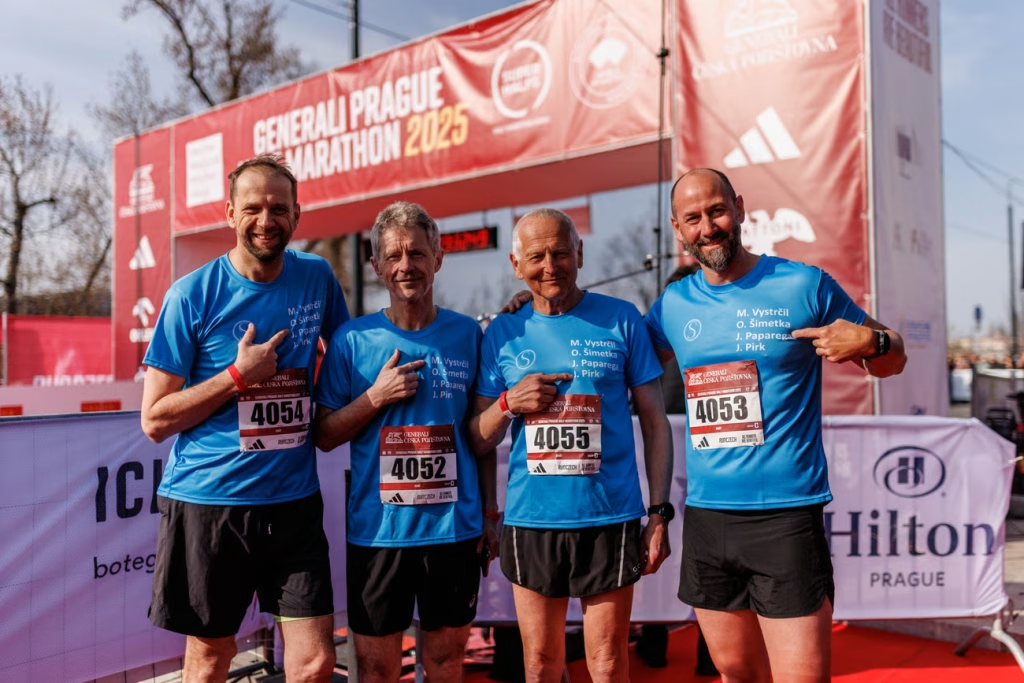
Running is not only a passion for renowned cardiac surgeon and Czech senator Jan Pirk—it is also a source of energy, balance, and long-term health. Even at an advanced age, he remains an active recreational runner and regularly participates in long-distance races. Within the RunCzech series, he has completed the half marathon in an impressive time of around 1 hour and 28 minutes.
Now, he is preparing for the Generali Prague Half Marathon 2026, where he will once again form a relay team with fellow senators Jan Paparega, Ondřej Šimetka, and Senate President Miloš Vystrčil.
At the beginning of May (3.5.2026), Professor Pirk will also line up at the start of the Prague International Marathon.
In an interview, the internationally recognized heart surgeon spoke about the impact of running and physical activity on both physical health and mental well-being.
Running is considered one of the healthiest forms of physical activity. What impact does regular running have on our health?
Running, together with walking, is the most natural form of human movement. It is also one of the most liberating and affordable sports. You don’t need a gym, a sports hall, a swimming pool, or even a competitor. The only thing you really need is a pair of running shoes.
At the same time, calorie expenditure over a given period is much higher than in activities such as cycling. For recreational running, a sixty-minute session is usually sufficient, while cycling would require roughly three times as much time to achieve a similar effect.
Cross-country skiing may be even healthier than running, but it requires expensive equipment and, most importantly, snow—something we see less and less of today.
Of course, it depends on the individual, but how often should we run to benefit our health and perhaps improve our fitness?
For health, it is enough to run three times a week for about sixty minutes at a certain heart-rate intensity.
This intensity can be roughly calculated using the formula 220 minus your age, and then taking 60 to 75 percent of that number. If you don’t use a watch that measures heart rate, a good guideline is a pace at which you can still comfortably hold a conversation with someone running next to you.
This is known as aerobic training, which gradually improves endurance and overall performance. A training session lasting 45 to 60 minutes also strengthens the immune system.
Anyone with experience in endurance running will confirm another interesting effect. During such runs, people often find solutions to problems they had previously been struggling with. Simply put, the brain receives better blood circulation.
Running as an important tool of a healthy lifestyle also has a significant economic impact on society, something you, from your position as a cardiac surgeon, perceive very clearly. Can this benefit be quantified more precisely?
The economic impact has two sides. First, it benefits the individual who exercises. You are healthier and suffer far less from lifestyle-related diseases such as being overweight, high blood pressure, type 2 diabetes, and coronary heart disease. The old rule still applies: a healthy mind in a healthy body.
Secondly, it benefits society as a whole. People who exercise regularly need fewer medications and fewer hospital stays. Moreover, organizing international running events brings substantial economic benefits to the cities that host them. For example, Prague has become a running center not only in Europe thanks to the activities of RunCzech. People come here from all over the world, often accompanied by family or friends.
How often should we exercise in general, in your opinion?
We do not have to just run; we can also swim or cycle. In general, we should engage in some form of physical activity at least three times a week. At the same time, we should also include strength training, because with increasing age people gradually lose muscle mass.
You are personally known for your positive relationship—even love—for running. What does this lifestyle bring you psychologically?
Besides allowing you to enjoy life more even at an older age, physical activity leads to an interesting effect. The body releases so-called endorphins, the hormones responsible for a good mood. Once you get used to feeling good in this way, you start to miss running when you cannot do it—for example during a cold, when it is better not to exercise—and you begin to look forward to your next run.
What distance or surface do you prefer?
I prefer running on soft surfaces, especially forest trails. But with good running shoes I also run on asphalt, typically distances between seven and twelve kilometers.
Within the RunCzech series, you will again take part in the Generali Prague Half Marathon and the Prague International Marathon together with your fellow senators in May. Could you share some of your personal records in endurance races?
My personal best in the marathon is 3 hours and 14 minutes. My half marathon time is 1 hour and 28 minutes, I ran the Běchovice race in 38 minutes, and Velká Kunratická in under 15 minutes. But that was a long time ago.